 EN


Why Precise Tonnage Calculation Matters in Modern Manufacturing
Within the fast-paced realm of modern sheet metal fabrication, industrial precision stands as the foundational cornerstone of operational profitability, structural integrity, and long-term shop floor efficiency. Overseeing heavy industrial manufacturing operations, supervising shop floor technicians, and consulting for global metalworking facilities frequently reveals a common operational pitfall: production delays, damaged machinery, and expensive scrapped components stemming from a single critical miscalculation regarding press brake tonnage estimation. Underestimating the required bending force can lead to incomplete forming, unacceptable angular inconsistencies, and unpredictable springback behavior that ruins expensive raw materials. Conversely, applying excessive tonnage poses severe risks to the structural frame of the machine, accelerates premature tool wear, and creates catastrophic safety hazards for shop floor operators. Mastering the science and advanced mathematics of tonnage calculation is no longer optional; it serves as the definitive operational differentiator between mediocre production throughput and world-class manufacturing excellence. Furthermore, maintaining strict compliance with safety margins ensures that production environments remain secure and highly predictable over years of continuous heavy-duty operation. Addressing these foundational engineering principles early in the workflow prevents costly workplace accidents and optimizes resource allocation across large-scale manufacturing facilities globally.
The Standard Formula and Key Variables Explained
At the heart of every successful air bending or bottoming operation lies a universally accepted metallurgical and mechanical formula. To calculate the required bending tonnage accurately, mechanical engineers rely on a direct mathematical relationship involving plate thickness, total bend length, and the die opening width. The standard industrial formula applied globally is expressed through specific parameters calibrated for standard mild steel possessing a typical tensile strength baseline. Understanding how each of these variables exponentially impacts the overall force requirement—especially the plate thickness, which operates on a squared mathematical scale—allows skilled technicians to optimize tooling selections before a single sheet of metal touches the machine bed, drastically reducing trial-and-error waste, material loss, and costly setup downtime. Additionally, incorporating these foundational calculations early in the production planning workflow prevents costly downstream bottlenecks and enhances overall component quality across varied batch sizes and custom production runs.
Factoring in Material Tensile Strength and Grain Direction
While standard mathematical formulas provide a reliable foundational baseline, authoritative metallurgical guidelines dictate that real-world material variances must always be thoroughly accommodated during production planning. Different metallic alloys possess distinct tensile strengths that directly scale the calculated tonnage requirements up or down. For instance, austenitic stainless steel typically demands significantly more bending force than standard low-carbon steel due to its higher work-hardening rate, whereas softer aluminum alloys may require lower tonnage thresholds. Furthermore, professional operators must carefully account for the material's internal grain direction; performing a bend perpendicular to the grain direction versus parallel to it alters the structural resistance of the sheet. Factoring in these nuanced physical and metallurgical properties ensures that tonnage calculations remain impeccably accurate across diverse industrial sectors, spanning everything from automotive chassis fabrication to complex aerospace structural components and heavy machinery enclosures. Evaluating these material characteristics thoroughly eliminates guesswork during high-stakes metal fabrication projects.
A Real-World Shop Floor Case Study
Observing these theoretical principles in active manufacturing practice highlights the importance of data-driven workflows in heavy fabrication facilities dealing with structural mounting brackets manufactured from marine-grade stainless steel across extended bend lengths. Utilizing standard V-die opening rules, novice calculations often overlook specific elongation limits and high tensile strengths, leading to severe tool binding or angular springback failure. By systematically applying corrective material multipliers and selecting optimized V-die geometries, expert engineering teams determine precise forming forces prior to execution. This methodical approach allows operators to program CNC crowning and press brake controllers accurately on the initial pass, successfully achieving rigorous angular tolerances without inflicting any marring or surface damage on high-value materials. Documenting these precise adjustments creates a valuable knowledge base for future projects involving high-strength alloy processing and intricate bending configurations.
Optimizing Production with Advanced Industry Solutions
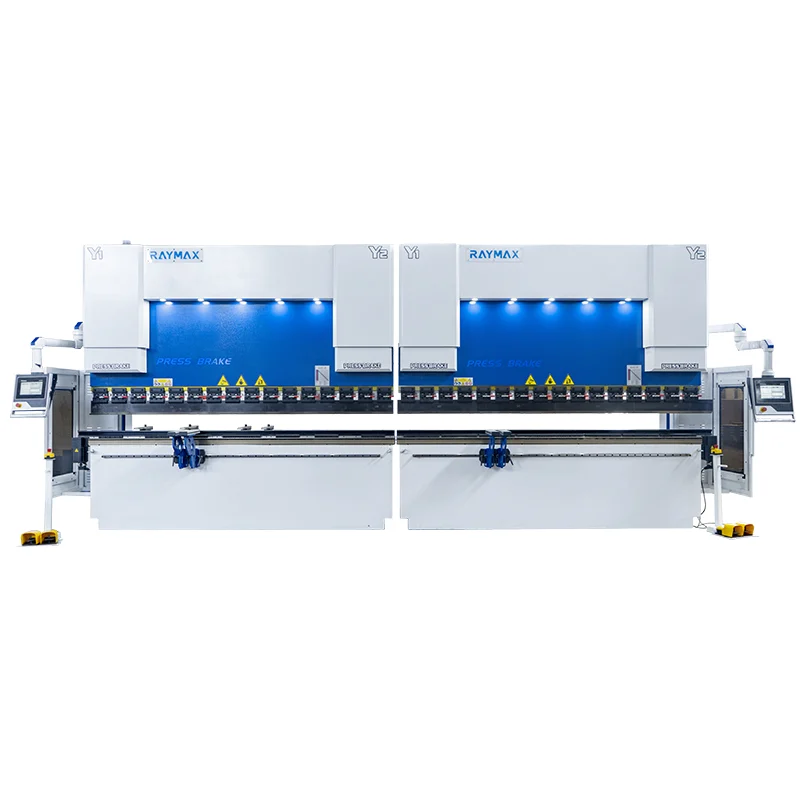
Even the most meticulous mathematical calculations and rigorous engineering preparations require a dependable, high-performance machine tool to execute design visions flawlessly on the shop floor. This is precisely where advanced manufacturing infrastructure transforms operational capability and market competitiveness. RAYMAX seamlessly combines decades of specialized sheet metal machinery manufacturing expertise with state-of-the-art CNC control technologies. Whether deploying high-precision CNC press brakes for intricate architectural panels or scaling heavy industrial production lines, machinery from RAYMAX is expertly engineered to deliver stable, highly repeatable tonnage distribution across the entire bed length. Backed by robust global supply chain services, stringent international quality certifications, and responsive, expert technical support, RAYMAX empowers manufacturing enterprises worldwide to turn complex engineering calculations into seamless, highly profitable production realities. Furthermore, comprehensive factory capabilities ensure that every machine is tailored to withstand rigorous, continuous industrial cycles, providing the long-term reliability and heavy-duty performance that modern industrial manufacturers demand.