A critical support system for accuracy and efficiency in long-sheet bending
In sheet metal forming, the bending of long workpieces poses a persistent dual challenge of accuracy and stability. When sheet dimensions reach 2,500 mm and extend beyond 6,000 mm, the influence of the workpiece's own weight on the process can no longer be ignored. A CNC press brake can precisely govern the ram stroke, yet if the sheet sinks, slips or twists during forming, the machine's positioning accuracy will never reach the part. The sheet follower was developed to close exactly this gap: an auxiliary forming system whose core function is to keep the support platform synchronized with the bending motion of the sheet, providing continuous and stable support throughout the process.
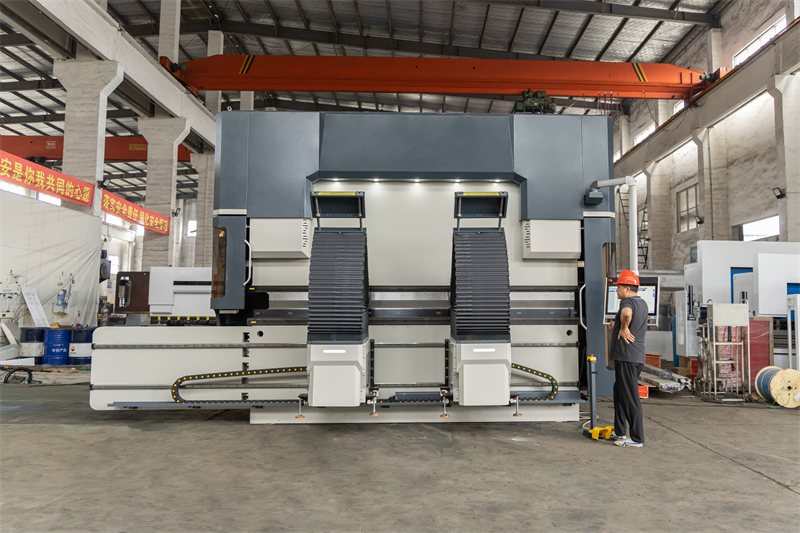
From a mechanical standpoint, the longer the sheet, the greater the bending moment its own weight exerts about the bend line; the thinner the sheet, the less its inherent rigidity can maintain a planar state. Taking a 4,000 × 1,500 × 4 mm carbon steel plate as an example, its volume is 0.024 m³; at a density of 7,850 kg/m³, the plate weighs approximately 188 kg. Under manual support, such workpieces are subject to the following problems during forming:
These factors compound one another, ultimately manifesting as reduced bend angle consistency, higher rework rates and constrained throughput.
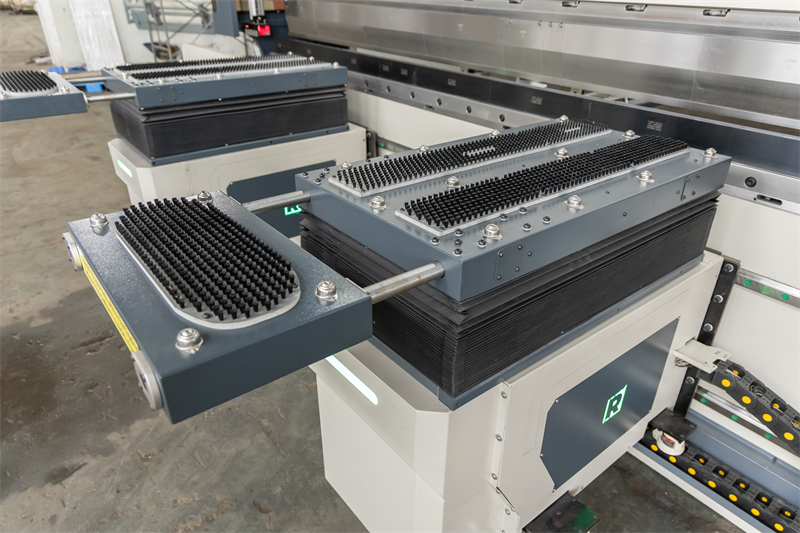
A sheet follower typically comprises five elements: the support platform, the swing arm, the drive system, the control system and the guide rail assembly. The support platform contacts the workpiece directly and carries the load; the swing arm performs the raising, flipping, following and returning motions; the drive system is powered pneumatically, by servo motor or by electric cylinder depending on the equipment tier; the control system coordinates the follower motion with the movements of the main machine.
The core component of synchronization is the displacement sensor. Mounted on the ram, the sensor acquires the slide's position and speed in real time and transmits the signal to the follower's control system, which drives the support platform to mirror the upward flip motion of the sheet. This synchronization covers the complete process cycle of ram descent, bending, holding and return, ensuring that the workpiece never loses contact with its support.
In high-end configurations, the follower links directly to the machine's CNC system: each bending step carries its own support parameters (support height, flip angle, follow speed and return position), switched automatically by the program between steps, achieving unattended synchronized control.
|
Parameter |
Typical Range |
|
Maximum load capacity |
80 – 150 kg (rated on a 1,250 × 2,500 mm sheet) |
|
Table length |
800 – 2,000 mm |
|
Table extension length |
2,000 – 2,500 mm |
|
Table width |
500 – 600 mm |
|
Working height |
800 – 1,200 mm |
|
Flip angle range |
0 – 45° |
|
Maximum flip speed |
40 – 100 °/s |
|
Dual-machine linkage |
For sheets over 4 m, master-slave linkage of two units |
Note: the values above are typical ranges from publicly available industry configurations, provided for technical reference only; actual performance parameters of Zhongrui machines are subject to the factory configuration.
Bending accuracy depends on the geometric stability of the workpiece during forming. By supporting both ends of a long sheet at the same height, the follower eliminates unbalanced loading and keeps the bend angle consistent across the full length. It also removes the disturbance of sagging and slippage to the positioning datum, allowing the machine's positioning accuracy to act truly on the part, and significantly improves repeatability in batch production.
The follower eliminates non-value-adding actions: waiting for a helper, re-positioning after sagging and adjusting the support between steps. With single-operator, single-machine operation, the operator only loads, positions, starts the program and unloads, shortening cycle time and raising batch throughput.
Once the device carries the main weight of the sheet, the auxiliary operator formerly assigned to hold the plate can be redeployed to another workstation. From a total cost of ownership (TCO) perspective, a one-time equipment investment replaces recurring labor expenditure and pays itself back through reduced rework hours.
With roller or low-friction support surfaces, the sheet rolls or glides over the support during the flip instead of dragging, effectively preventing scratches on stainless steel, aluminum and painted surfaces, and satisfying applications with strict surface quality requirements.
The sudden drop or toppling of large sheets is a primary safety hazard in bending operations. As the follower bears the weight of the sheet, operators no longer need to hold the workpiece in close proximity during forming, substantially reducing the risk of uncontrolled heavy loads.
Along its technology evolution path, the follower system is upgrading from manual holding to servo following, CNC linkage, dual-machine linkage and, ultimately, robotic flexible bending cells:
Throughout this evolution, the sheet follower has grown from a mere auxiliary device into a critical functional module that determines the efficiency, stability and automation level of large sheet metal bending.
Through synchronized support technology, the sheet follower systematically resolves the compounding process problems of self-weight deformation, positioning drift and human error in long-sheet bending, delivering combined benefits across accuracy, efficiency, labor, surface quality and safety. For manufacturers focused on long sheets, thin sheets and high-volume sheet metal parts, the sheet follower has become an indispensable standard configuration for CNC press brakes.
 EN
EN