 EN
EN



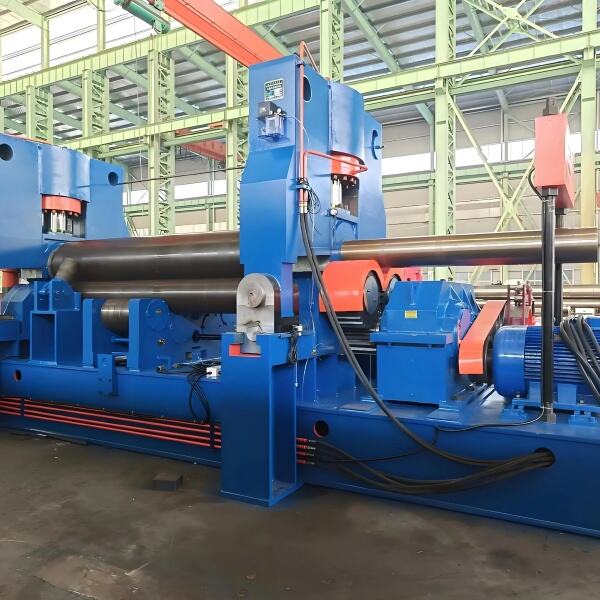
Three-Roll vs. Four-Roll Rolling Machines: Key Differences and Use Cases
Three roll machines work great for simple cylinder bends on materials like steel or aluminum plates up to around 50mm thick, making them a budget friendly option for smaller shops. The four roll versions take things further with an extra top roller that sits there passively but makes a big difference. Manual feeding gets cut down by about two thirds, which is a game changer for anyone dealing with thick sheets. The concentricity improves too, hitting around plus or minus 0.1mm accuracy something manufacturers need when building pressure vessels. And there's another benefit this fourth roller lets operators do helical rolling in one go through the machine. No more stopping and adjusting midway like they have to with three roll systems. Wind turbine companies love this feature because it saves time during those long sheet metal jobs for tower sections.
Two-Roll and Variable-Geometry Machines for Specialized Plate Forming
Variable-geometry rolling machines, with asymmetric roller positioning, excel at forming complex shapes like hyperboloids and truncated cones, maintaining angular accuracy within ±1.5°. Two-roll systems specialize in curving ultrathin sheets (0.5–2 mm), commonly used in HVAC ducting, but lack the force capacity (max 150 kN) required for structural components.
Pyramid, Initial Pinch, and Double-Pinch Configurations Compared
| Configuration | Plate Pre-Bend Required | Minimum Diameter Capability | Ideal Material Hardness (HV) |
|---|---|---|---|
| Pyramid | Yes | 300 mm | 150–250 |
| Initial Pinch | No | 80 mm | 80–180 |
| Double-Pinch | No | 50 mm | 50–130 |
Double-pinch designs are preferred in stainless steel food processing equipment production, where tight radii help prevent bacterial accumulation in crevices.
When to Choose Which Rolling Machine Style Based on Bending Complexity
When dealing with thick shipbuilding plates that need to be bent at least 100 mm or more, pyramid roll setups tend to handle the job just fine. They've got enough muscle power for these tough applications. On the other hand, when working with those super thin aerospace grade titanium sheets where even the slightest deviation matters, four roll machines become the go to option. We're talking about tolerances around 0.05 mm per meter here, which is pretty much hair splitting territory. And then there's the whole world of architectural bronze pieces with all their complex curves. These require something special, like variable axis systems equipped with full 8 axis CNC controls. Without this kind of advanced machinery, getting those intricate shapes right simply isn't possible.
Evaluate Material and Mechanical Requirements for Optimal Rolling Performance
Match Rolling Machine Power to Material Type, Thickness, and Yield Strength
When picking out rolling machine power specs, yield strength matters more than tensile strength in most cases. Take stainless steel for example. A one inch thick sheet with around 60 thousand pounds per square inch yield strength needs roughly thirty percent extra torque compared to aluminum sheets of similar thickness. The ASM International study from last year backs this up. Real world materials aren't always perfect though. There are always those unexpected variations plus the effects from cold working processes. That's why experienced operators typically go for machines that can handle about twenty percent more load than what calculations suggest. It gives some breathing room when things don't go exactly according to plan during production runs.
Calculate Required Rolling Capacity Using Thickness-Width-Yield Formulas
The standard formula T × W × (YS/900) determines minimum roll force (in tons), where:
- T = Material thickness (inches)
- W = Workpiece width (inches)
- YS = Yield strength (PSI)
For example, rolling 0.5" thick carbon steel (YS: 36,000 PSI) across a 72" width requires over 1,440 tons of force. Modern CNC controllers automate these calculations, reducing setup errors by 42% (Fabrication Tech Journal, 2023).
Determine Maximum Working Width and Minimum Bend Diameter Needs
| Material | Minimum Bend Diameter | Working Width Range |
|---|---|---|
| Aluminum 6061-T6 | 2.5× thickness | 12"–144" |
| A36 Steel | 3.8× thickness | 12"–96" |
Thicker materials (>1") demand reinforced side frames to maintain accuracy. Four-roll machines achieve deflection tolerances as tight as 0.01" on widths exceeding 100", making them suitable for large-scale, high-precision jobs.
Align Rolling Machine Size and Precision with Application Demands
Matching machine capabilities to application requirements is crucial for efficient plate bending. For complex geometries such as cones or asymmetrical parts, flexibility is key—three-roll variable-geometry systems with ±0.03" tolerance adapt well to multiple radii, while four-roll setups eliminate flat spots in oval profiles.
Forming Cones, Ovals, and Asymmetric Shapes: Machine Flexibility Matters
Variable-axis rolling machines reduce setup time by 40% compared to fixed-geometry models when producing conical sections. Asymmetrical components benefit from double-pinch systems that maintain consistent curvature despite uneven material distribution. For ovals with width-to-height ratios exceeding 10:1, CNC-controlled side rollers ensure angular deviation remains below 1° along the bend length.
High-Precision Industries: Why Aerospace and Energy Favor Four-Roll Machines
Around 72 percent of all four-roll machines get bought by aerospace companies because they need super consistent curvature measurements at 0.001 inches per foot according to the Fabrication Tech Report from last year. The machines basically stop metal from slipping when working with tough materials such as titanium or Inconel thanks to those massive hydraulic clamps that can hit pressures of 12,000 pounds per square inch. For folks in the energy business making wind towers, the newer dual drive versions of these four roll setups produce flange rings with much better precision compared to traditional three roll systems. We're talking about improvements somewhere between 30 to maybe even 50 percent tighter tolerances which makes a big difference in how well everything fits together down the line.
Balancing Machine Size, Accuracy, and Part Geometry Tolerances
| Parameter | Three-Roll Target | Four-Roll Target |
|---|---|---|
| Minimum Bend Diameter | 1.2x Plate Thick | 0.8x Plate Thick |
| Thickness Range | 0.25"-6" | 0.1"-8" |
| Repeatability (10hr run) | ±0.015" | ±0.005" |
Workshops handling mixed production batches should consider machines with automatic crown compensation, which maintains ±2% dimensional accuracy when switching between thin 14-gauge stainless steel and thick 2" AR400 plate.
Scale Machine Selection to Production Volume and Business Objectives
High-Volume Fabrication: Automation and Throughput in Modern Rolling Machines
In large scale manufacturing settings, automated rolling systems equipped with programmable controls and continuous feeding can process well over 1,200 plates during a single work shift. These systems come with features such as quick change tooling and automatic crowning mechanisms that maintain consistent curvature formation, even when working with thick materials like 100 mm ASTM A36 steel plates. Many production facilities that manufacture more than 50 thousand annular components each year have started using four roll configurations paired with robotic material handling. The main advantage here is the dual bending action which removes the need for separate pre curving processes. This typically reduces overall cycle times anywhere from 35 to 50 percent when compared against traditional pyramid style three roll machines still used in some older facilities.
Cost-Benefit Analysis: Three-Roll vs. Four-Roll Systems for Medium-Scale Workshops
| Factor | Three-Roll Machine (Initial Pinch) | Four-Roll Machine (Double-Pinch) |
|---|---|---|
| Initial Cost | $180,000–$350,000 | $420,000–$850,000 |
| Labor Efficiency | 2 operators for full-cycle tasks | 1 operator with automated tilt |
| Minimum Diameter | 1.2× material thickness | 0.8× material thickness |
| Tolerances (EN 10029) | ±2° angular deviation | ±0.5° angular deviation |
For shops handling around 200 to 800 plates each month, three-roll systems are usually the go-to choice because they cut down on overall costs by roughly 20 to 35 percent. Sure, these setups require more hands-on work for complicated shapes, but the money saved often makes up for it. When dealing with tougher materials that have over 450 MPa yield strength or trying to shape things like those tricky elliptical tanks, four-roll machines start making financial sense. The special zero-end-flat feature on these machines can actually slash secondary machining expenses between 18 and 22 percent. Looking at recent data from a survey conducted in 2024 across 87 different fabrication facilities, about two thirds of medium volume operations managed to get their money back on four-roll investments within just under two and a half years thanks to less wasted material and better chances at landing bigger contracts.
FAQs
What are the main advantages of four-roll rolling machines over three-roll ones?
Four-roll machines reduce manual feeding significantly, improve concentricity, and allow for one-pass helical rolling, making them ideal for thicker materials and large production batches.
Are two-roll systems suitable for structural components?
No, two-roll systems are best for curving ultrathin sheets and lack the force capacity required for structural components.
Which configurations are preferred for stainless steel food processing equipment?
Double-pinch designs are favored because they achieve tight radii that prevent bacterial accumulation in stainless steel food processing equipment.
When is it advisable to use variable-geometry rolling machines?
Variable-geometry rolling machines are ideal for forming complex shapes like hyperboloids and truncated cones, thanks to their asymmetric roller positioning and accuracy.
Table of Contents
- Three-Roll vs. Four-Roll Rolling Machines: Key Differences and Use Cases
- Two-Roll and Variable-Geometry Machines for Specialized Plate Forming
- Pyramid, Initial Pinch, and Double-Pinch Configurations Compared
- When to Choose Which Rolling Machine Style Based on Bending Complexity
- Evaluate Material and Mechanical Requirements for Optimal Rolling Performance
- Align Rolling Machine Size and Precision with Application Demands
- Scale Machine Selection to Production Volume and Business Objectives
- FAQs