 EN
EN



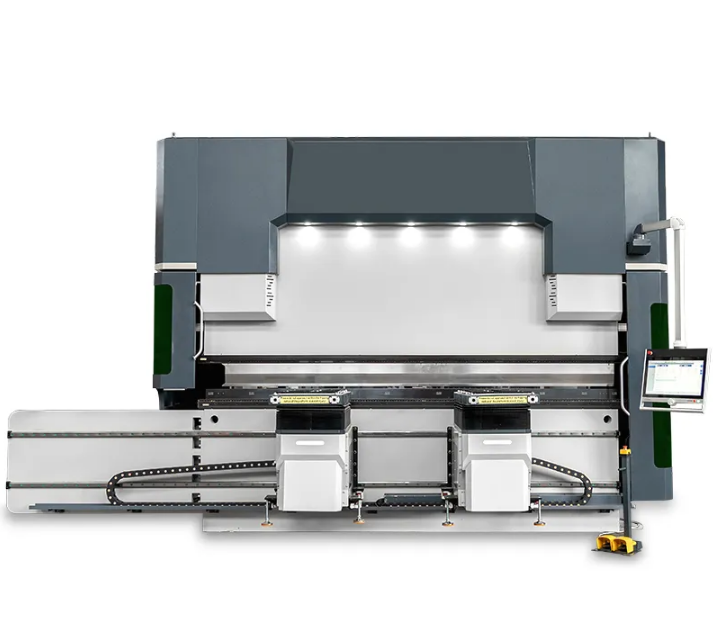
Where the Cylinder Count Decision Actually Starts
The debate between single-cylinder and twin-cylinder hydraulic press brake configurations comes up regularly in equipment selection discussions, and it tends to get oversimplified. A single larger cylinder versus two synchronized smaller cylinders isn't just a mechanical topology choice. It affects synchronization accuracy, bending consistency across the full beam length, and how the machine behaves when forming asymmetric tooling loads.
Understanding the mechanical differences helps cut through the marketing language and focus on what actually matters for a given application.
Synchronization Mechanics and Deflection Behavior
A single-cylinder press brake positions the cylinder at or near the center of the upper beam. The beam deflects in a predictable bow pattern under load, with maximum deflection at center. Most single-cylinder machines above 40-ton capacity use mechanical or hydraulic crowning on the lower beam to compensate for this, which adds a maintenance variable to the system.
Twin-cylinder machines distribute the load through two cylinders, typically positioned at roughly one-third and two-thirds of the beam length. Electrohydraulic synchronization, using position transducers at each cylinder, continuously corrects for differential pressure or flow variation to keep both cylinder rods at equal extension throughout the stroke. According to specifications from leading CNC press brake controller manufacturers including Delem and Cybelec, modern twin-cylinder synchronization systems can maintain ram parallelism within 0.02 mm across the full stroke, which matters considerably for long-part bending.
| Parameter | Single-Cylinder | Twin-Cylinder |
|---|---|---|
| Typical capacity range | 20-200 ton | 80-2000+ ton |
| Synchronization method | Mechanical or fixed | Electrohydraulic, closed-loop |
| Ram parallelism tolerance | 0.05-0.1 mm typical | 0.01-0.03 mm typical |
| Crowning requirement | Often needed above 40T | Built into cylinder control |
| Asymmetric load handling | Limited | Better managed |
| Hydraulic system complexity | Lower | Higher |
| Maintenance access | Simpler | More components |
Performance on Long-Part and Off-Center Bending
Where single-cylinder machines show their limitations most clearly is in off-center bending. When a part positions the bend line significantly away from the center of the beam, the torque imbalance on a single central cylinder creates a yawing moment on the beam. The beam compensates partially through its structural stiffness, but the deflection that remains translates directly into angular error on the formed flange.
A sheet metal fabricator producing long enclosure panels for electrical switchgear ran into this issue with a single-cylinder 100-ton machine. Bends placed within 300 mm of the machine centerline were within tolerance, but parts requiring a 1200 mm offset from center consistently showed a 0.4-degree angular deviation. Switching to a twin-cylinder configuration of equivalent tonnage resolved the angular error without any tooling changes.
Twin-cylinder machines are specifically better suited for asymmetric tooling setups, where punches of different lengths are placed at various positions across the beam, because the per-cylinder pressure can be independently adjusted to balance the forming load.
Hydraulic Circuit Complexity and Maintenance Considerations
Single-cylinder machines have a simpler hydraulic circuit by definition. One cylinder, one set of proportional valves, one set of position transducers. Troubleshooting is more straightforward, and the component count for a seal replacement job is lower.
Twin-cylinder circuits double most of the hydraulic components, and the synchronization system adds electronic control loops that require calibration after seal replacement or when sensor drift is detected. Facilities without dedicated hydraulic maintenance capability should factor in access to qualified service support when evaluating twin-cylinder machines.
The operational advantage of twin-cylinder accuracy is real, but so is the maintenance complexity. For low-volume shops or those primarily bending shorter parts below 1500 mm, a well-maintained single-cylinder machine with proper crowning adjustment often delivers acceptable results at a lower overall cost.
Control System Integration and Backgauge Coordination
Modern press brake performance depends as much on the CNC control system as on the hydraulic configuration. Both single and twin-cylinder machines benefit from multi-axis backgauge control, automatic tool setup functions, and bend sequencing software that calculates optimal part rotation to minimize handling steps.
Twin-cylinder machines typically integrate better with high-axis-count control systems because the synchronization data from each cylinder feeds into the control loop. This makes them a better match for automation integration, including robotic panel bending cells where the controller needs precise ram position data at every point in the stroke for path planning calculations.
Making the Selection Based on Your Actual Work
The right choice comes down to the material mix and part geometry that will actually run on the machine, not the theoretical maximum capability. For thick-plate short parts below 2000 mm where angular tolerance is plus or minus 0.5 degrees, a single-cylinder machine performs adequately. For thin material long parts above 2000 mm, or asymmetric tooling layouts, the twin-cylinder design's synchronization accuracy pays for itself in reduced part rejection rate and less shimming time at setup.
RAYMAX offers hydraulic press brakes in both single-cylinder and twin-cylinder configurations, with CNC controller options ranging from standard 2-axis to 8-axis synchronized control, allowing the machine specification to match the actual forming complexity of the work being run.
Table of Contents
- Where the Cylinder Count Decision Actually Starts
- Synchronization Mechanics and Deflection Behavior
- Performance on Long-Part and Off-Center Bending
- Hydraulic Circuit Complexity and Maintenance Considerations
- Control System Integration and Backgauge Coordination
- Making the Selection Based on Your Actual Work