 EN
EN



Why Square Tubes Present Different Challenges Than Flat Sheet
Most fabricators who move from flat sheet cutting to tube processing underestimate how different the programming and setup requirements really are. A tube laser cutting machine handles round, square, and rectangular profiles, but square and rectangular tubes introduce a specific set of challenges: corner geometry transitions, surface flatness variation on the flat faces, and the need for the cutting head to maintain a consistent focal distance as it tracks around a 90-degree corner.
The physics at the corner are worth understanding. As the laser head transitions from a flat face to the corner radius, the focal point depth changes relative to the material surface. Most modern tube laser systems compensate for this automatically through capacitive height sensing, but the response lag during rapid direction changes can still affect cut quality if feed rates aren't adjusted at corner approach points.
Clamping, Feed Chuck Configuration, and Material Prep
Before the first cut happens, the material handling setup determines much of what follows. Square tube stock often arrives with minor twist along the length, particularly in thinner wall profiles. A tube that enters the machine with even a 2-degree twist will track off-axis as the chuck rotates for profiling cuts, producing angular error on features that should be perpendicular to the tube axis.
Checking twist before loading and rejecting stock that exceeds tolerance is faster than trying to compensate in post-processing. Most tube laser suppliers specify a maximum twist-per-meter value for stock that the machine can reliably handle.
The front and rear chuck grip pressure also matters more on square tube than round. Round tube self-centers under symmetric grip pressure. Square tube requires that the chuck jaw faces align with the flat sides of the profile. Misaligned jaws create micro-rotation during the feed cycle, which shows up as positional drift on successive features.
Programming Approach for Intersecting Cuts and Miter Joints
Square tube is heavily used in structural fabrication, and that means a large share of the cutting work involves miter joints, saddle cuts, and end notching for weld fit-up. Programming these cuts on a tube laser follows a different logic than flat-sheet nesting.
The cutting software needs accurate cross-section data for the tube, including the corner radius. Most cold-formed square tube has a corner radius of roughly 1.5 to 3 times the wall thickness. If the program treats the corner as a true right angle, the actual cut will deviate from the programmed path at every corner transition, and the fit-up on a miter joint will show a gap even when the dimensions look correct on the print.
| Cut Type | Common Application | Key Programming Parameter | Typical Tolerance Achievable |
|---|---|---|---|
| Straight end cut (90 deg) | Tube frame assembly | Feed rate at corner approach | +/- 0.2 mm |
| Miter cut (45 deg) | Corner joints, handrails | Corner radius compensation | +/- 0.3 mm |
| Saddle cut (cope cut) | Intersecting tube frames | Tube OD and wall thickness accuracy | +/- 0.5 mm |
| Slot and tab notch | Weld positioning | Kerf width offset setting | +/- 0.15 mm |
Gas Selection and Pressure Settings for Different Wall Thicknesses
Assist gas choice on tube laser cutting affects both cut edge quality and the dross behavior on the inside of the tube. For mild steel tube, oxygen-assisted cutting produces a faster cut at lower power but leaves an oxide layer on the cut face. Nitrogen cutting produces a cleaner, oxide-free edge but requires higher pressure and power settings.
For thin-wall square tube (below 3 mm), nitrogen at 12 to 16 bar typically produces the cleanest result. For thicker wall sections above 6 mm, oxygen assist becomes more practical from a cost and throughput standpoint, especially where edge quality will be obscured by weld finishing.
A fabrication project at a structural components supplier in Jiangsu ran into a recurring dross problem on 4 mm wall mild steel square tube. Switching from oxygen at 6 bar to nitrogen at 14 bar eliminated the internal dross issue entirely, though cutting speed dropped by approximately 15%. The trade-off was acceptable given that the parts were going into a visible architectural application where grinding marks were not permitted.
Focus Position and Power Density for Thick-Wall Square Tube
For square tube with wall thickness above 5 mm, focus position relative to the material surface has a more pronounced effect on edge quality than in thin-sheet applications. A focus set at the top surface maximizes power density at entry but leaves a wider kerf at the exit face. Setting focus at mid-wall produces more uniform kerf geometry through the thickness.
Most fiber laser tube cutting systems allow focus offset adjustment in the CNC parameter set. Running cut quality test samples at focus offsets of 0, -1 mm, and -2 mm on a specific material and thickness combination takes about 20 minutes but establishes the optimal parameter set that will hold across production runs.
Post-Cut Handling and End Deburring
The cut ends of square tubes from laser processing are generally cleaner than mechanically sawed ends, but burr formation on the inner corners of the profile is a known issue, particularly at corners where the laser path changes direction. Inner corner burrs on square tube are harder to reach with standard deburring tools.
An end deburring tool specifically designed for square and rectangular profiles addresses this more effectively than round-profile deburring sets. For high-volume production, inline deburring attachments that work with the tube laser's automated bundle loader systems are available from several tooling suppliers.
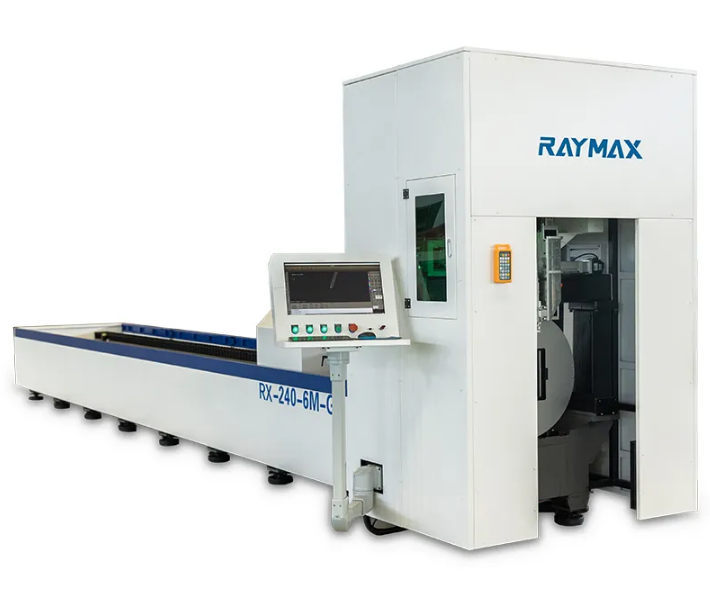
RAYMAX tube laser cutting machines are configured to handle the full range of square and rectangular profile sizes with chucking and height sensing systems designed to maintain cut accuracy through the geometry transitions that make square tube processing more demanding than flat sheet work.
Table of Contents
- Why Square Tubes Present Different Challenges Than Flat Sheet
- Clamping, Feed Chuck Configuration, and Material Prep
- Programming Approach for Intersecting Cuts and Miter Joints
- Gas Selection and Pressure Settings for Different Wall Thicknesses
- Focus Position and Power Density for Thick-Wall Square Tube
- Post-Cut Handling and End Deburring