 EN
EN


Understanding the Real Risks Before Touching the Blade Guard
Shearing machine safety gets treated like a checklist item at a lot of facilities, something to run through during onboarding and then quietly set aside. That attitude tends to hold until an incident changes the culture overnight. Hydraulic guillotine and swing beam shears operate with blade forces that can exceed 200 tons on heavier-gauge configurations, and the blade gap on commercial units typically sits between 0.02 mm and 0.05 mm per millimeter of material thickness. At those tolerances, the margin for operator error is essentially zero.
The most reliable safety outcomes come from teams that treat procedural knowledge and equipment setup as equally important, not from relying on blade guards alone.
Pre-Shift Inspection Points That Actually Matter
Most machine incidents trace back to conditions that existed before the shift started. A proper pre-operation check on a hydraulic shear covers more than a visual scan.
1.Check hydraulic fluid level and look for seepage around cylinder fittings and hose connections.
2.Confirm the blade clearance setting matches the material scheduled for that shift. A clearance set for 6 mm mild steel will tear rather than cleanly cut 2 mm stainless.
3.Test the emergency stop circuit by triggering it intentionally and confirming the ram doesn't coast after activation.
4.Inspect the back gauge positioning stops for wear or play. A back gauge that shifts under load produces dimensional scatter across a batch.
5.Confirm the foot pedal guard is engaged if manual mode is being used.
Skipping any of these takes roughly three minutes off the setup time and can add hours to a maintenance call later.
Blade Clearance, Rake Angle, and Why Both Affect Safety
The relationship between blade clearance and rake angle is frequently misunderstood, even by operators with years of seat time. Blade clearance controls the quality of the cut edge and the force required. Rake angle determines how the shear force distributes across the cut length.
A rake angle that's set too high reduces peak cutting force but increases material distortion, which causes sheet movement during cutting. Sheet movement is a direct cause of operator hand proximity incidents, because material that shifts unpredictably pulls attention toward repositioning rather than blade travel.
The European machinery safety standard EN ISO 11684 recommends that all cutting zone guarding be designed to prevent access while the blade is in motion, and that blade travel time be factored into guard interlocking delay calculations. Suppliers providing CE-marked shearing equipment should be able to produce documentation confirming compliance with this standard.
Personal Protective Equipment: What the Data Shows
| PPE Category | Minimum Specification | Common Failure Mode |
|---|---|---|
| Cut-resistant gloves | ANSI/ISEA 105 Level A4 or EN 388 Level D | Wearing gloves rated for abrasion only, not cut resistance |
| Safety footwear | ASTM F2413 or EN ISO 20345 with steel toe | Soft-toe safety shoes that don't meet impact rating |
| Eye protection | ANSI Z87.1 impact-rated safety glasses | Standard prescription lenses without side shields |
| Hearing protection | NRR 25+ for continuous operation | Single-use foam inserted improperly, reducing effective NRR by 30-50% |
A 2021 Bureau of Labor Statistics analysis of metalworking injuries in the United States found that hand and finger injuries accounted for 38% of all recorded incidents in shearing and punching operations, with the majority occurring during material handling rather than active cutting. That breakdown is important because it shifts where training time should be concentrated.
Two-Operator Work and Communication Protocols
Large sheet handling on shears wider than 2500 mm almost always involves two operators, and that introduces a coordination hazard that single-operator work doesn't have. The operator at the control side may activate the foot pedal while the secondary operator is still repositioning the sheet.
A lockout protocol for two-person shearing work should include a verbal or visual clear signal before any activation, with the second operator physically stepping back from the work zone. Some facilities use a two-hand enable button arrangement on the secondary side to ensure both operators are clear before the cycle can start. This approach mirrors the dual palm button logic used on press brakes under EN 574 standards.
After the Cut: Handling Scrap and Burr Management
Cut edges on sheared mild steel carry a burr that varies with blade sharpness and clearance setting. A fresh blade with correct clearance on 4 mm mild steel produces a burr height typically below 0.1 mm. A worn blade running at excessive clearance can generate burrs above 0.5 mm, sharp enough to cut through standard work gloves.
Scrap bin placement and edge handling procedures are often where facilities accumulate the most minor injuries. Having a dedicated scrap chute, using edge-rolling tools before stacking, and establishing a blade-change trigger based on measured burr height rather than elapsed run time are all practical steps that reduce exposure.
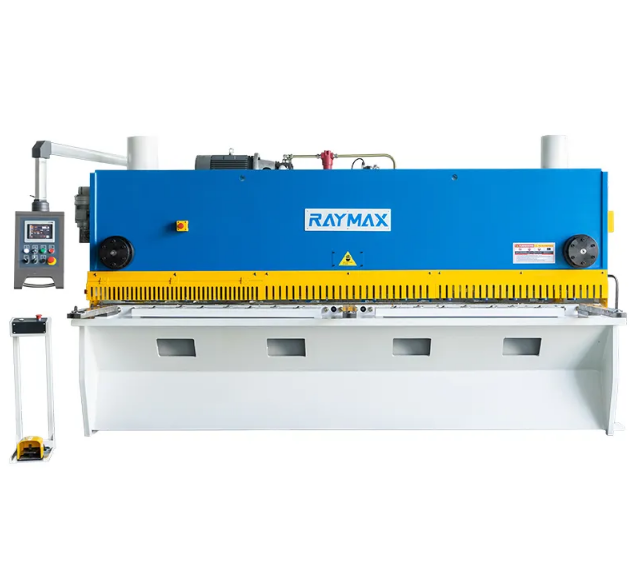
RAYMAX shearing machines are built with blade clearance adjustment mechanisms and back gauge systems designed to support these kinds of operational controls, giving facilities a hardware foundation that makes consistent safety practice more achievable rather than entirely dependent on operator discipline.
Table of Contents
- Understanding the Real Risks Before Touching the Blade Guard
- Pre-Shift Inspection Points That Actually Matter
- Blade Clearance, Rake Angle, and Why Both Affect Safety
- Personal Protective Equipment: What the Data Shows
- Two-Operator Work and Communication Protocols
- After the Cut: Handling Scrap and Burr Management