 EN
EN


How the Three-Roller Rolling Machine Works: Principles of Precision Bending
What Is a Three-Roller Rolling Machine and How Does It Work?
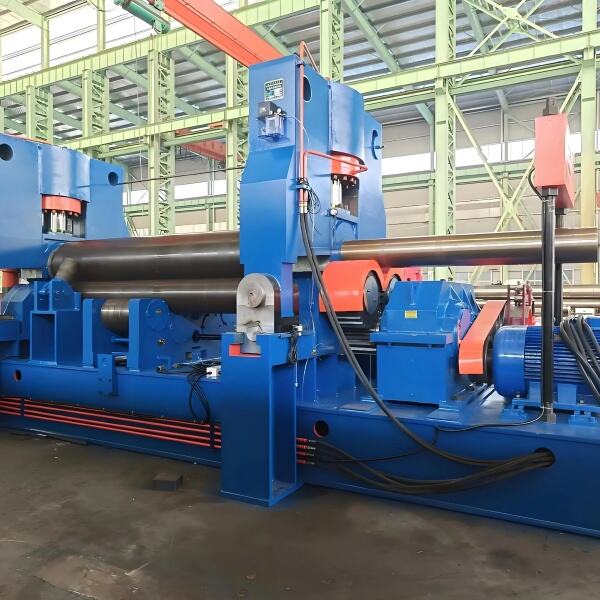
Three roller rolling machines work by applying either hydraulic or mechanical force to shape flat sheets of metal into accurate cylinders. These systems typically have an adjustable top roller sitting between two bottom rollers that are actually powered. The bottom ones grab hold of the metal piece and pull it along as they spin together. When this happens, the friction from the spinning motion moves the metal through the machine, while at the same time the top roller comes down with just the right amount of pressure to start forming that curve we need. This setup allows for pretty precise shaping without warping or damaging the material too much during processing.
Plastic Deformation of Metal Plates Through Roller Pressure and Rotation
When metal gets bent beyond its yield point, usually around 200 to 400 MPa for most steel alloys, it undergoes plastic deformation that changes its shape permanently. Getting this right depends heavily on how well those rollers line up so stress spreads out properly across the whole plate surface. These days, manufacturers can get pretty accurate bends too, often within plus or minus 0.1 degrees per meter. They do this by adjusting rotation speeds somewhere between 3 and 15 revolutions per minute. The exact speed matters though since different materials react differently based on their thickness and hardness characteristics.
Role of Upper, Lower, and Side Rollers in the Rolling Process
- Upper roller: Controls bend radius through vertical positioning (adjustment range: 50–500 mm)
- Lower rollers: Provide driving force via gear-coupled motors (15–75 kW typical)
- Side rollers (asymmetrical models): Enable edge pre-bending through ±30° tilt adjustments
Symmetrical vs Asymmetrical Three-Roll Configurations: Mechanics and Applications
In symmetrical three roll bending machines, the top roller sits right in the middle of the two fixed bottom ones. These setups work great for making lots of basic cylindrical parts like pipes or tubing. The asymmetrical version is different though it has rollers positioned off center which lets manufacturers bend edges before final forming without needing extra tools something that really matters when dealing with tough materials like stainless steel or titanium. Some recent tests found these asymmetrical systems cut down on setup time around 40 percent for tricky shapes such as cones or tapered sections. There's a tradeoff though since they need much more precise alignment about half the tolerance of standard systems at plus or minus 0.05 millimeters instead of 0.2 mm. Most shops find this worth it for complicated jobs where speed counts.
Core Components of the RAYMAX Three-Roller Rolling Machine
Precision-Engineered Main Rollers for Consistent Cylinder Formation
At the heart of the RAYMAX machine are three main rollers that handle the actual bending work. These rollers can reach diameters as large as 400 mm, and their surfaces are hardened to over 55 HRC through induction heating processes. The top and bottom rollers spin together in sync, while the side ones move up and down to fine tune the curve radius. This triangle setup really helps reduce bending when heavy loads are applied something absolutely essential when working with steel plates up to 40 mm thick. The result? Cylinders formed with incredible precision straightness deviations stay below 0.5 mm per meter across the entire length. For anyone dealing with demanding metal forming tasks, this kind of stability makes all the difference in quality outcomes.
Hydraulic vs Mechanical Drive Systems in Modern Rolling Machines
Hydraulic systems dominate industrial applications due to their 20–30% higher energy efficiency and smoother pressure control (±1.5% variation) compared to mechanical drives. RAYMAX machines use closed-loop hydrostatic systems that maintain 50–300 bar working pressures, enabling force outputs up to 1,200 kN while reducing maintenance costs by 40% over mechanical chain drives (DurmaPress 2024).
Advanced Control Systems for Real-Time Thickness and Shape Regulation
An integrated HMI with 7-inch touchscreens coordinates servo motors and hydraulic valves to achieve ±0.1° angular positioning accuracy. Automatic thickness compensation algorithms adjust roll gaps during operation, compensating for material springback variations up to 15%—a feature particularly valuable for stainless steel and aerospace alloys.
Structural Frame and Alignment Mechanisms Ensuring Long-Term Accuracy
The 250 mm thick welded steel frame provides <0.02 mm/m rigidity under full load, while laser-aligned roller bearings maintain parallelism within 0.05 mm across all axes. According to manufacturing engineering studies, this structural stability reduces cumulative forming errors by 78% over 10,000 operating hours compared to conventional frames.
The Complete Three-Roll Plate Rolling Process: From Setup to Final Form
Pre-Bending Techniques to Eliminate Straight Edges Without Secondary Tooling
Three roll plate rolling starts with what's called pre-bending. Operators lift those side rollers to give the metal sheet some curve at each end first. Without this step, most sheets would still have those annoying flat spots left over from regular bending methods. What makes this approach so good is how it creates consistent curves all the way through the material. Traditional setups needed extra equipment for similar results, but newer systems like RAYMAX have built this right into their design. Setup times drop around 35% when working with sheets no thicker than 25mm according to recent industry numbers from last year.
Step-by-Step Cylindrical Forming Process on a RAYMAX Rolling Machine
- Alignment: Position the plate parallel to the front roller, with 10–15 mm overhang to account for springback
- Clamping: Secure the sheet between the upper and lower rollers at preset hydraulic pressures (typically 18–22 MPa)
- Feed rotation: Activate the drive system to feed the plate through the rollers while gradually increasing curvature
This automated process achieves angular precision within ±0.5°, making it ideal for pressure vessel manufacturing.
Optimizing Roll Passes and Feed Angles for High-Precision Results
| Parameter | Thin Plates (<6mm) | Thick Plates (>20mm) |
|---|---|---|
| Roll passes | 1–2 | 3–5 |
| Feed angle | 15°–25° | 5°–12° |
| Speed | 8–12 m/min | 2–4 m/min |
CNC-controlled systems automatically adjust these parameters in real time, compensating for material variations while maintaining ±0.2 mm radial consistency.
Post-Rolling Roundness Correction and Quality Assurance Methods
After initial forming, operators use laser scanning to measure deviations from perfect circularity. The machine’s side rollers then apply micro-adjustments at 0.01 mm increments. For critical applications like wind turbine towers, this stage reduces ovality to <0.1% of diameter.
Managing Springback and Material Variability in Precision Bending
Springback compensation algorithms automatically calculate required overbending based on material yield strength (250–550 MPa), temperature fluctuations (±15°C), and sheet width-to-thickness ratio (5:1 to 100:1). Advanced systems achieve final dimensional accuracy within 0.5 mm/m, even when processing high-strength alloys like ASTM A514.
Advantages and Limitations of Three-Roller Plate Rolling Technology
Efficiency, Flexibility, and Versatility in Industrial Cylinder Production
Three roller plate rolling machines tend to be pretty cost effective when it comes to making cylinders, especially with thinner materials around 12mm thick or less. The simpler design means maintenance usually runs about 30 to maybe even 50 percent cheaper than those fancy four roller setups. Machines with hydraulic drives take things one step further too. They can knock out batches much quicker, roughly 20% faster cycles for big production runs without sacrificing quality. Bending stays pretty accurate too, generally staying within half a millimeter either way. These machines just work better for certain applications where budget matters but precision still counts for something.
- Single-pass production of conical and circular shapes without retooling
- Compatibility with carbon steel, stainless steel, and aluminum alloys (thickness range: 1–40 mm)
- Compact footprints ideal for small-batch workshops
Edge Pre-Bending Challenges and Solutions in Standard Configurations
Symmetrical three roller setups have one major problem that everyone knows about by now the straight edges left on metal plates after processing which means extra work for those secondary pre bends. But things are changing thanks to some clever engineering solutions lately. We've got adjustable side rollers that handle edge curling right there during production, plus those fancy CNC controls that automatically tweak feed angles and pressure settings as needed. And don't forget the hybrid asymmetric designs that actually allow proper three point bending without all the hassle. The result? Around 98 percent success rate on first pass pre bending operations. When edge consistency absolutely matters, combining standard three roller systems with some pre bending equipment gives pretty much the same quality as expensive four roller machines but costs only about 40 percent what those would set a business back initially.
Achieving Maximum Precision with RAYMAX Rolling Machines
How RAYMAX Engineering Ensures Repeatable Accuracy in Every Bend
The RAYMAX three roller machines maintain around 0.1 mm dimensional consistency thanks to their hardened steel rollers featuring micro ground surfaces with surface roughness below 0.4 micrometers, plus CNC guided alignment systems that keep everything straight. According to research published in 2024, these machines incorporate real force feedback sensors which cut down angular deviations by about two thirds when compared with regular hydraulic systems. This means they can produce consistent bends even after thousands of cycles, sometimes over ten thousand. The synchronized servo motor drives also play a role here, adjusting rotation speeds every half second or so to handle materials varying in thickness from thin sheets right up to 40 mm thick plates.
Maintaining Tight Tolerances in High-Volume Manufacturing Environments
Automated thickness monitoring via laser scanners and machine learning algorithms reduces out-of-spec defects by 82% in high-volume production runs. Statistical process control (SPC) dashboards track roller deflection patterns, enabling proactive recalibration before tolerance thresholds exceed ±0.25°—critical for aerospace and energy storage cylinder applications requiring ISO 2768-f compliance.
Balancing Speed and Precision in Modern Cylinder Manufacturing
Adaptive speed algorithms optimize cycle times by 30% without sacrificing accuracy, processing 6–8 meter-long plates in under 90 seconds. Dual-mode operation supports rapid prototyping (5–15 RPM) and high-volume runs (25–40 RPM), while temperature-compensated roller bearings maintain positional accuracy within 0.05 mm/m even during sustained operation.
Integration with Digital Controls and Industry 4.0 Readiness
IoT-enabled models feature predictive maintenance sensors that forecast roller wear with 94% accuracy, reducing unplanned downtime by 60%. OPC-UA compatibility allows seamless data integration with ERP/MES platforms, automating QA documentation and process optimizations through closed-loop feedback systems.
FAQ
What is the primary function of a three-roller rolling machine?
The primary function is to shape flat metal sheets into accurate cylinders using hydraulic or mechanical forces.
How does a three-roller machine achieve plastic deformation?
Plastic deformation occurs as the roll pressure exceeds the metal's yield point, altering its shape permanently.
What are the differences between symmetrical and asymmetrical configurations?
Symmetrical configurations position the top roller centrally for basic cylindrical shapes, while asymmetrical ones are offset to enable pre-bending of edges without extra tools.
How do RAYMAX machines ensure precision?
RAYMAX machines use precision-engineered rollers and advanced control systems to maintain high levels of precision.
What are the advantages of using hydraulic systems over mechanical ones?
Hydraulic systems are more energy-efficient and provide smoother pressure control than mechanical systems.
Table of Contents
- How the Three-Roller Rolling Machine Works: Principles of Precision Bending
- Core Components of the RAYMAX Three-Roller Rolling Machine
-
The Complete Three-Roll Plate Rolling Process: From Setup to Final Form
- Pre-Bending Techniques to Eliminate Straight Edges Without Secondary Tooling
- Step-by-Step Cylindrical Forming Process on a RAYMAX Rolling Machine
- Optimizing Roll Passes and Feed Angles for High-Precision Results
- Post-Rolling Roundness Correction and Quality Assurance Methods
- Managing Springback and Material Variability in Precision Bending
- Advantages and Limitations of Three-Roller Plate Rolling Technology
- Achieving Maximum Precision with RAYMAX Rolling Machines
-
FAQ
- What is the primary function of a three-roller rolling machine?
- How does a three-roller machine achieve plastic deformation?
- What are the differences between symmetrical and asymmetrical configurations?
- How do RAYMAX machines ensure precision?
- What are the advantages of using hydraulic systems over mechanical ones?