Customized services to meet individual needs
brake press-0
brake press-1

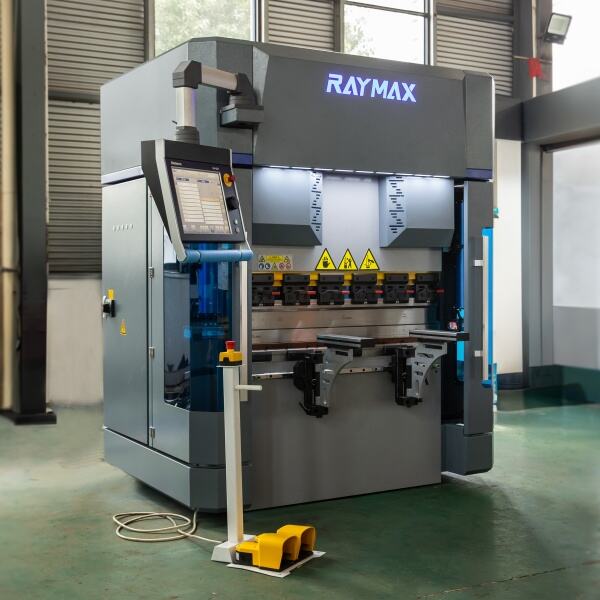
RAYMAX Servo Press Brake – Battery-Powered Portable Model for Off-Grid Bending

RAYMAX servo press brake is available in a battery-powered portable version, using a 48V lithium-ion battery pack and a 2kW servo drive, allowing metal bending in locations without grid power. The 20-ton, 1.0m press brake can perform 500 bends on 2mm steel per charge. A solar charging option is available. The machine weighs 350kg and has lifting handles. Applications include on-site construction, disaster relief shelter fabrication, and military field workshops. RAYMAX includes a battery management system with state-of-charge display. The servo press brake retains full precision (0.01mm ram positioning) even on battery power. This is the world’s first cordless press brake.
Get A Quote

Why choose us?

60% Energy Savings Compared to Traditional Hydraulic Press Brakes

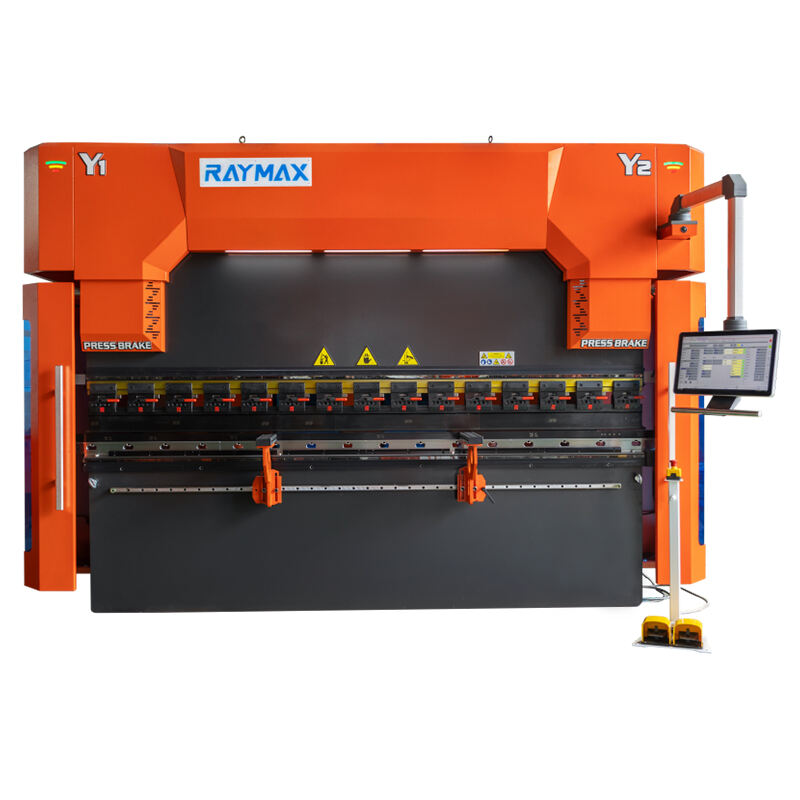
RAYMAX servo press brake adopts fully electric servo design, achieving bending accuracy as high as 0.01mm error per bend point while saving up to 60% of the power consumed compared to traditional hydraulic systems. With no oil or oil pressure valves requiring regular replacement, the servo press brake eliminates issues where oil temperature changes affect processing accuracy. The electric servo press brake is driven by an efficient servo motor to achieve energy saving and pollution-free operation, providing more precise control, faster bending speed, and higher machining accuracy. The regenerative braking system recovers energy during the ram's return stroke, further reducing total power consumption. RAYMAX servo press brake operates 20% quieter than equivalent hydraulic models, improving operator comfort.

Clean Operation for Pharmaceutical and Food-Grade Applications

RAYMAX servo press brake runs at noise levels below 68 dB, making it suitable for noise-sensitive environments like pharmaceutical cleanrooms and food packaging plants. The all-electric design eliminates hydraulic oil, removing contamination risks and simplifying sanitation procedures. With energy consumption of only 3 kWh per 100 bends (6mm mild steel), this servo press brake offers the lowest operating cost in its class. The compact footprint and low weight (only 1.8 tons for a 1.5m model) allow installation on elevated factory floors or in container workshops. Perfect for medical device housings, food machinery parts, and electronics chassis. RAYMAX provides a 3-year warranty on all servo motors and ball screws, reflecting our confidence in long-term reliability.

Fast Approach Speed up to 500 mm/s for High-Volume Production

RAYMAX servo press brake achieves an industry-leading approach speed of 500 mm/s (compared to typical 150–200 mm/s), reducing non-productive time by 60%. The pressing speed is adjustable from 1 to 50 mm/s, and the rapid cycling speed reaches 25 strokes per minute on 1mm material, making it suitable for high-volume production of small parts such as electronic brackets, hinge components, and clips. The high speed is achieved by oversized servo motors and low-inertia ball screws. RAYMAX provides a cycle time calculator to quantify productivity gains. Our RX-H series hybrid servo 8-axis CNC press brake is equipped with all independent axes plus full servo and intelligent control systems, offering the greatest degree of freedom and strongest control capabilities in its class.

Related products

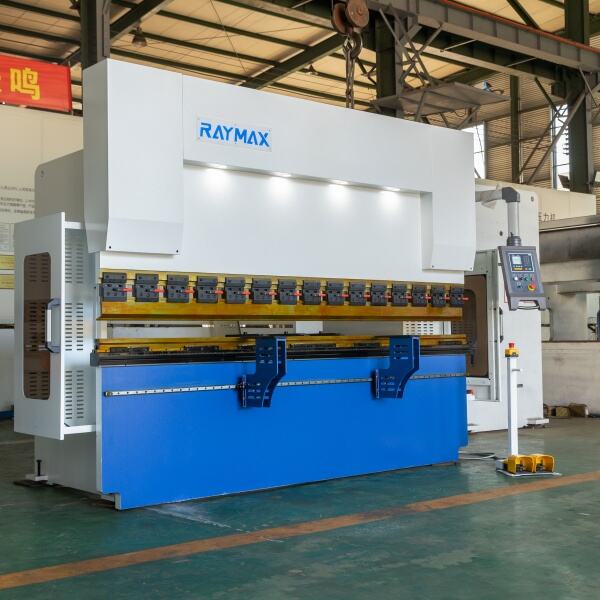
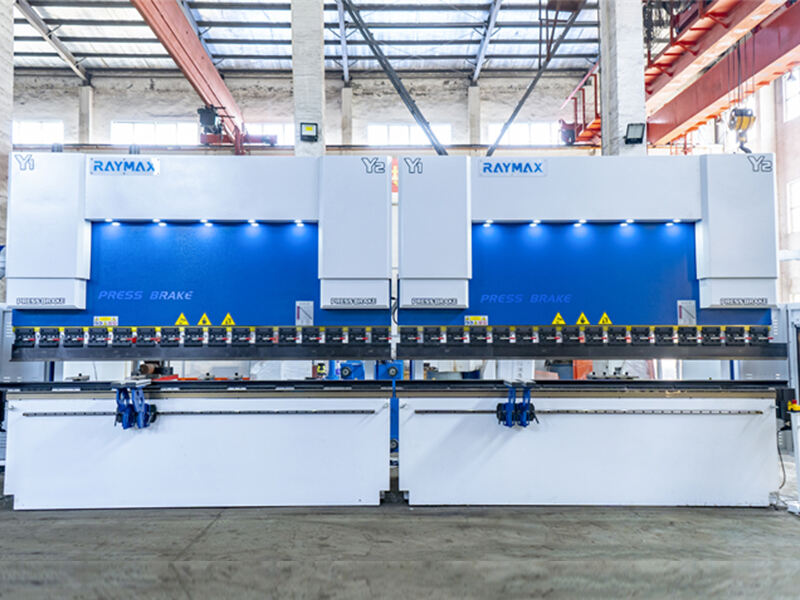
Tandem servo press brake configurations address a critical manufacturing challenge: bending extremely long metal sheets and structural components that exceed the working length of any single machine. By synchronizing two or more press brakes operating side by side, a tandem setup combines their working lengths and tonnages to handle parts such as wind tower panels, long structural beams, and road lamp poles. Raymax's tandem press brakes use fully closed-loop electro-hydraulic servo control technology, which is ideal for ensuring perfect synchronization. Slider position signals are fed back to a shared CNC system via bilateral gratings, which then adjusts the synchronous valve openings to control oil flow. This ensures that the rams (Y1 and Y2 axes) on both machines run at the same frequency, maintaining perfect parallelism across the entire combined worktable. The flexibility of a tandem configuration is a major advantage. When processing ultra-long sheets, the two machines operate as a single, unified press brake with exceptional precision. When not processing long parts, the two machines can be separated and used independently to handle different tasks, effectively doubling production capacity for standard-size parts. This dual-mode capability maximizes equipment utilization and ROI. The CNC system automatically controls table deflection compensation across the combined length, ensuring uniform bend angles even on the longest workpieces. Tandem servo press brakes are ideal for construction (long metal beams), shipbuilding (large hull sections), and renewable energy (wind tower components). Standard configurations include 2-100 ton by 3200mm up to 2-300 ton by 3200mm, with custom configurations available for larger lengths. Our tandem press brakes can process extra-long workpieces up to 8 meters or longer, with switchable stand-alone or dual-operating modes. Contact us to discuss tandem servo press brake configurations optimized for your extra-long part processing requirements.
Frequently Asked Questions

What key functions does an ironworker machine combine?

An ironworker machine integrates punching, shearing, notching, and bending in a single setup. It can punch holes up to 32mm in diameter, shear 6-12mm steel plates, and achieve bending angles up to 135°, greatly reducing the need for separate machines.
Fiber laser welding is 4-10 times faster, produces a significantly smaller heat-affected zone (minimizing distortion), and offers better energy efficiency with lower consumable costs. The process also creates clean, spatter-free welds that often require no secondary finishing.
Hydraulic press brakes offer greater control over pressure and speed, are quieter, and are better suited for thick or hard materials. They also tend to have longer service lives due to reduced mechanical strain.
Fiber laser welding machines can weld multiple materials including stainless steel, aluminum, copper, carbon steel, titanium alloys, and other metals, with adjustable parameters to accommodate different thicknesses and material types.

Related Articles

Working Principle Of Tandem Press Brake

27

Nov

Working Principle Of Tandem Press Brake

View More
Fiber Laser Cutting Machine: Precision Cutting for Complex Parts

27

Nov

Fiber Laser Cutting Machine: Precision Cutting for Complex Parts

Why Fiber Laser Cutting Machines Excel in Precision ManufacturingHow Fiber Laser Cutting Supports Precision and Accuracy in Sheet Metal CuttingFiber laser cutters can get down to micron level precision thanks to their incredibly fine beam focus, some...
View More
How a Press Brake Improves Precision in High-Volume Sheet Metal Production

27

Nov

How a Press Brake Improves Precision in High-Volume Sheet Metal Production

How CNC Controls Enable Precision in Metal BendingCNC systems, which stands for Computer Numerical Control, can achieve really fine precision in press brake work when they sync up those hydraulic or electric actuators with the programmed instructions...
View More
CNC Press Brake vs NC Press Brake: Which Is Right for Your Shop?

27

Nov

CNC Press Brake vs NC Press Brake: Which Is Right for Your Shop?

Core Differences Between CNC and NC Press BrakesCNC (Computer Numerical Control) press brakes differ fundamentally from NC (Numerical Control) systems in their technological architecture and operational capabilities. While NC machines rely on pre-pro...
View More

Customer Reviews

David Chen

RAYMAX servo press brake achieves ±0.003mm repeatability with high-precision ball screws and linear guides driven by independent servo motors on each side of the ram. The CNC controller coordinates both motors electronically, allowing the ram to tilt for off-center bending without sacrificing parallelism accuracy. The dynamic crowning feature commands the ram to follow a convex or concave path to compensate for bed deflection. We use this machine for precision brackets for electronics enclosures. The positioning accuracy and fast 300 mm/s speed have increased our productivity. RAYMAX provided a calibration certificate for the positioning system. The machine holds its accuracy across thousands of identical parts. This is the most precise press brake we have ever used.

Steven Chen

The 500 mm/s approach speed on RAYMAX servo press brake reduced our non-productive time by 60% compared to standard models. The adjustable pressing speed from 1 to 50 mm/s and rapid cycling of 25 strokes per minute on 1mm material have increased our throughput for small electronic brackets and hinge components. The oversized servo motors and low-inertia ball screws enable this high speed. The cycle time calculator provided by RAYMAX helped us quantify the productivity gains. The machine has been running 8-hour shifts daily for our high-volume production. The energy consumption is minimal. RAYMAX's engineering team helped us optimize our bending sequences to take full advantage of the fast approach speed. This servo press brake has become essential for our mass production line.

Get a Free Quote

Our representative will contact you soon.
Email
Mobile/WhatsApp
Name
Company Name
Message
0/1000
60% Energy Savings with All-Electric Servo Design

60% Energy Savings with All-Electric Servo Design

RAYMAX servo press brake adopts all-electric servo design, saving 60% of power compared to traditional hydraulic systems while eliminating hydraulic oil changes and oil temperature variation issues. This machine achieves bending accuracy of 0.01mm per bend point, operates with low noise, and maintains stable performance without oil temperature drift. With high-speed back gauge and precision dual-servo motor spindle drive, the servo press brake enables stable high-speed processing for precision sheet metal, mass production of electronic parts, and new energy vehicle lightweight components in cleanroom environments.