Customized services to meet individual needs
portable laser welder-0
portable laser welder-1

RAYMAX Laser Welding Machine – Seam Tracking with Structured Light for Lap Welds on Car Body Panels

RAYMAX laser welding machine integrates a structured light sensor that projects a laser line onto the workpiece and detects seam position in real time, automatically guiding the welding head along lap joints, butt joints, and fillet welds. This system compensates for part misalignment up to ±1.5mm. The 2kW fiber laser welds 1.5mm automotive steel at 5 m/min. A teach mode allows manual recording of complex paths. Applications include automotive body-in-white assembly, appliance cabinet welding, and battery tray fabrication. RAYMAX offers a demo program where customers send sample parts for seam tracking validation before ordering.
Get A Quote

Why choose us?

Non-Contact Welding for Heat-Sensitive Applications

RAYMAX laser welding machine covers fiber, CO₂, and semiconductor laser sources, delivering non-contact welding with no electrode wear and beautiful, consistent welds. The pulsed Nd:YAG laser (up to 300J per pulse) produces weld spots as small as 0.3mm with minimal heat spread, making it suitable for heat-sensitive electronic components and medical device assemblies. The closed-loop feedback system maintains constant laser energy output regardless of line voltage fluctuations, ensuring weld consistency across production batches. Applications include battery pack assembly, sensor housing sealing, and micro-switch contacts. The machine includes a built-in weld monitoring system that records power, speed, and focus for each weld, enabling traceability for ISO-certified processes. RAYMAX provides application training and process optimization support as part of every installation.

Welding of Dissimilar Metals with Intermetallic Control

RAYMAX laser welding machine features a special pulse shaping algorithm that controls heat input to minimize intermetallic compound formation when welding dissimilar metals such as steel to aluminum or copper to brass. The 2kW fiber laser with beam oscillation achieves strong joints (70% of base metal strength) for demanding applications. Applications include battery terminals (copper to aluminum), automotive lightweight structures, and electrical busbars. The machine's precise energy control allows welding of galvanized steel without burning off the zinc coating, and joining of titanium alloys for aerospace components. RAYMAX provides a process validation report for each dissimilar metal combination. This laser welding machine opens new possibilities for multi-material design in automotive, aerospace, and renewable energy industries.

Cost-Effective General-Purpose Welding Solution

RAYMAX offers cost-effective laser welding machines that balance performance and affordability, ideal for small businesses and general fabrication shops. Our general-purpose models offer basic laser welding functions with power up to 1kW, suitable for thin metal sheets (0.1-3mm) and featuring manual operation. These machines provide an affordable entry into laser welding technology without compromising on core quality. The compact design requires minimal floor space, and the simple controls reduce training time. RAYMAX's welding parameter library (preloaded for 30+ material combinations) helps operators achieve good results quickly. Perfect for custom fabrication shops, repair facilities, prototype development, and maintenance departments. RAYMAX provides installation guidance, operator training, and spare parts support through our global distribution network.

Related products

The comparison between fiber laser welding machines and traditional arc welding methods reveals fundamental differences that make fiber laser technology the preferred choice for many industrial joining applications in 2025. Fiber laser welding machines achieve welding speeds 4 to 10 times faster than TIG welding on equivalent material thicknesses, with a 1,500 watt handheld fiber laser welding machine completing welds at speeds of 0 to 120mm per second compared to TIG welding speeds of approximately 20 to 30mm per second. This speed advantage translates directly to labor cost reduction and increased production throughput, with manufacturers reporting cycle time reductions of 60 to 80 percent after converting to fiber laser welding. The heat-affected zone of fiber laser welding is typically less than 0.1mm for 1mm stainless steel, compared to 2mm to 5mm for TIG welding and 1mm to 3mm for MIG welding. This minimal thermal input dramatically reduces distortion, eliminating the need for post-weld straightening operations and preserving the mechanical properties of the base material. Consumable costs for fiber laser welding machines are significantly lower than for arc welding, with filler wire consumption reduced by 10 to 15 percent and shielding gas consumption reduced by 30 to 40 percent compared to TIG or MIG methods. The elimination of tungsten electrodes, contact tips, nozzles, and diffusers further reduces ongoing expenses. Energy efficiency provides another significant advantage, with fiber lasers achieving wall-plug efficiencies of 30 to 40 percent, meaning each kilowatt of laser output requires only 2.5 to 3.3 kilowatts of electrical input, compared to arc welding processes which convert only 5 to 10 percent of input power into usable heat at the weld. This translates to 50 to 70 percent lower energy consumption for equivalent production output. However, the initial capital investment for a laser welding machine is higher than for conventional arc welding equipment. A 1,500 watt fiber laser welding machine requires a higher upfront investment compared to a TIG welding setup. The return on investment period typically ranges from 12 to 24 months for high-volume operations, after which the lower operating costs and higher productivity provide sustained financial benefits. For low-volume applications or workshops with infrequent welding requirements, traditional arc welding may remain more cost-effective. The skill requirement for operators is significantly lower for laser welding, as the process eliminates the need for constant arc length adjustment, electrode manipulation, and precise torch angle control. A handheld laser welding machine can be operated effectively with minimal training, reducing the skilled labor bottleneck many fabrication shops face. Our laser welding machines are available with power ratings from 500W to 6,000W, with configurations ranging from entry-level handheld units to fully automated robotic welding cells. Contact us to schedule a comparative analysis between laser welding and your current arc welding methods.
Frequently Asked Questions

What types of tubes can a tube laser cutting machine process?

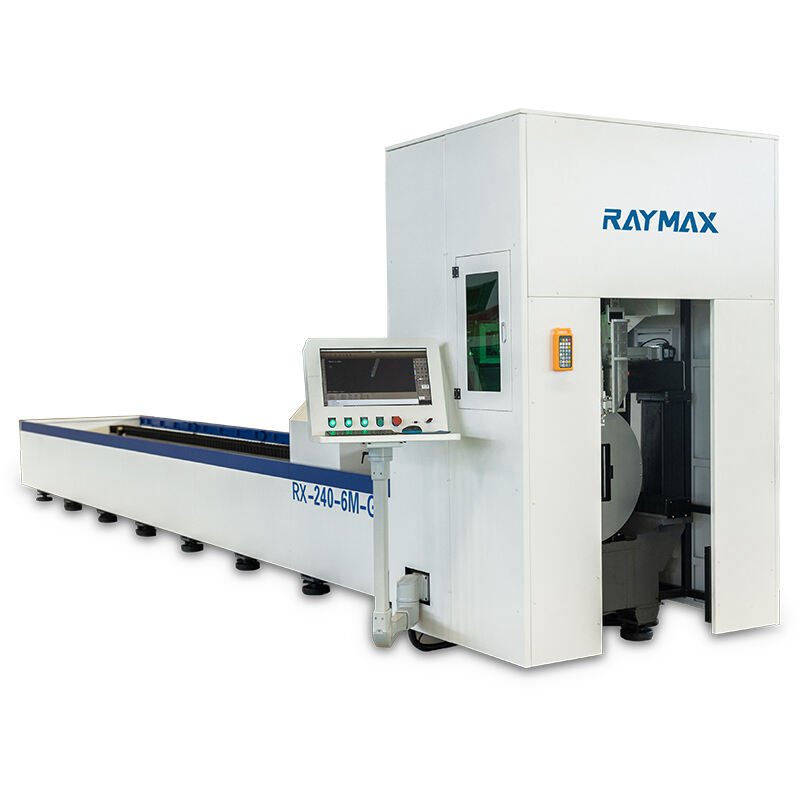
A tube laser cutting machine can process round tubes (20-200mm diameter), square tubes (20×20mm to 150×150mm), rectangular tubes, elliptical tubes, and U-tubes, with a maximum pipe length of up to 15,000mm.
Regular maintenance includes checking hydraulic oil levels, inspecting blade condition and gap adjustment (typically 5-10% of plate thickness), lubricating moving joints, cleaning electrical connections, and verifying safety interlock systems.
Plate rolling machines are extensively used in wind tower manufacturing to roll conical and cylindrical sections from high-strength steel plates (20-60mm thick), achieving roundness tolerances within ±1mm for proper fit-up during field erection.
RAYMAX serves automotive, shipbuilding, railway, aviation, power generation, petrochemical, and light industries, providing complete sets of metal sheet and profile processing machinery exported globally to Southeast Asia, Middle East, Western Europe, and South America.

Related Articles

Working Principle Of Tandem Press Brake

27

Nov

Working Principle Of Tandem Press Brake

View More
How To Use Fiber Laser Cutting Machine To Improve The Utilization Rate Of Sheet Metal?

27

Nov

How To Use Fiber Laser Cutting Machine To Improve The Utilization Rate Of Sheet Metal?

View More
What Are The Differences Between CNC Press Brake And NC Press Brake?

27

Nov

What Are The Differences Between CNC Press Brake And NC Press Brake?

View More
The 136th RAYMAX Canton Fair was kicked off

27

Nov

The 136th RAYMAX Canton Fair was kicked off

View More

Customer Reviews

Richard Chen

The structured light sensor on RAYMAX laser welding machine projects a laser line onto the workpiece and detects seam position in real time, guiding the welding head along joints even when parts are misaligned up to ±1.5mm. This feature reduced our rework significantly for automotive body-in-white assembly. The 2kW fiber laser welds 1.5mm automotive steel at 5 m/min. The teach mode allows manual recording of complex paths. The system integrates seamlessly with our automated production line. RAYMAX offered a demo program where we sent sample parts for seam tracking validation before ordering. The seam tracking accuracy has eliminated the need for precise fixturing, saving us tooling costs. This machine has improved our weld quality consistency across high-volume production.

Lisa Chen

As a small fabrication shop, we couldn't justify the cost of high-end laser welders, but RAYMAX offered an affordable general-purpose model that meets our needs perfectly. The 1kW fiber laser welds thin metal sheets from 0.1mm to 3mm with manual operation. The compact design fits in our limited floor space. The simple controls reduced training time for our welders. The preloaded welding parameter library for 30+ material combinations helped us get started quickly. The machine has been reliable for our custom fabrication work including stainless steel kitchen equipment and aluminum frames. RAYMAX provided installation guidance and operator training. The cost savings on consumables compared to TIG welding have been significant. This is a great entry point into laser welding technology.

Get a Free Quote

Our representative will contact you soon.
Email
Mobile/WhatsApp
Name
Company Name
Message
0/1000
Non-Contact Welding for Diverse Industrial Applications

Non-Contact Welding for Diverse Industrial Applications

RAYMAX laser welding machine offers non-contact welding with no electrode wear, producing consistent and aesthetically pleasing welds for electronics, automotive, aerospace, and medical device industries. Covering fiber, CO₂, and semiconductor laser sources, this machine integrates seamlessly with automated production lines. The closed-loop feedback system maintains constant laser energy output regardless of line voltage fluctuations, ensuring weld consistency. With applications including battery pack assembly, sensor housing sealing, and automotive lightweight components, RAYMAX provides a complete welding solution for precision manufacturing needs.