Customized services to meet individual needs
fibre laser welding machine-0
fibre laser welding machine-1

RAYMAX Fiber Laser Welding Machine – Wire Feeder Attachment for Filler Metal Welding of Gap Joints

RAYMAX fiber laser welding machine can be equipped with a motorized wire feeder that delivers filler wire (0.8–1.6mm diameter) to the weld pool, allowing welding of joints with gaps up to 2mm. The wire feed speed is synchronized with the welding speed via the CNC. The 2kW laser welds 4mm plate with filler. Applications include repair welding, joining of mismatched parts, and welding of galvanized steel where filler helps control zinc vapor. RAYMAX provides a wire guide nozzle kit and a filler material compatibility chart. The wire feeder attaches to the welding head in 10 minutes.
Get A Quote

advantage

Minimal Thermal Distortion for Precision Components

RAYMAX fiber laser welding machine produces a concentrated heat-affected zone (HAZ) as narrow as 0.2mm, significantly reducing thermal distortion compared to traditional TIG or MIG welding. This precision is critical for thin-wall components, electronic enclosures, and medical device assemblies where warping would compromise fit and function. The closed-loop feedback system maintains constant laser energy output regardless of line voltage fluctuations, ensuring weld consistency across production batches. Applications include lithium battery tab welding, stainless steel kitchen equipment manufacturing, sensor encapsulation, and automotive lightweight component assembly. RAYMAX provides process validation support to help customers optimize welding parameters for their specific materials and joint configurations.

Swing Welding Head for Gap Bridging and Flexible Angles

RAYMAX fiber laser welding machine features a swing welding head that can be used for welding at any angle or shape, with adjustable weld width from 0 to 6mm. The oscillation mode bridges gaps up to 1.5mm without filler wire, making it ideal for imperfect fit-ups in heavy equipment fabrication and automotive subframe assembly. The handheld option uses 10 meters of imported optical fiber, connects the laser head through a cable, and is equipped with automatic wire feeding, allowing welding of large, non-movable products over long distances. Available power options include 1000W, 1500W, and 2000W, with both continuous and pulse operating modes. Fresh operators can achieve professional results without requiring mature welding experience.

High-Speed Automated Welding with Robotic Precision

RAYMAX fiber laser welding machine integrates laser sources, robotic arms, and vision systems for fully automated operation. Our 6-axis robots achieve repeatability up to ±0.02mm, enabling complex 3D welding for automotive, aerospace, and medical device applications. The fiber laser delivers a 1070nm wavelength beam through a reinforced fiber cable, eliminating optical drift and ensuring consistent beam quality even after 10,000+ hours of operation. Welding speeds reach up to 120 mm/s with penetration depth of 3mm in stainless steel. Developed through our university research partnerships and refined by 60% technical staff, RAYMAX automated fiber laser welding systems enable scalable, high-volume production with minimal operator intervention.

Related products

Mold repair and tooling restoration applications have been transformed by the introduction of handheld fiber laser welding machines, which enable precision build-up welding of worn or damaged mold surfaces without the extensive heat input and subsequent post-weld heat treatment required by traditional TIG welding. Injection mold cores and cavities typically manufactured from tool steels such as P20, H13, and S136 develop wear at gate locations, parting lines, and sharp corners after extended production runs. Handheld fiber laser welding machines deposit filler metal in controlled layers as thin as 0.1 millimeters, building up worn areas to restore original dimensions while limiting the heat-affected zone depth to under 0.5 millimeters. The reduced heat input of fiber laser welding preserves the substrate's existing heat treatment, eliminating the need for complete mold re-heat treatment after repair, which can require 24 hours or more in a vacuum furnace. Wire feed speeds for mold repair welding range from 2 to 15 millimeters per second, with laser power adjusted between 200 and 800 watts depending on the filler wire diameter and deposition rate required. The ability to weld in any position without the gravity limitations of TIG welding makes handheld fiber laser welding machines particularly suitable for repairing internal mold features such as core pins, slide surfaces, and angled lifters. Post-weld machining requirements are reduced because fiber laser welding produces near-net shape deposits with minimal excess material, decreasing CNC machining time for final finishing by 50 to 70 percent compared to TIG repair. For stamping die repair where wear occurs on cutting edges and forming surfaces, fiber laser welding machines deposit wear-resistant tool steel filler metals that achieve hardness values of 55 to 60 Rockwell C in the as-welded condition. Contact our mold repair specialists to discuss handheld fiber laser welding machine configurations optimized for your specific tool steel types and repair applications.
Frequently Asked Questions

What materials can a fiber laser cutting machine process?

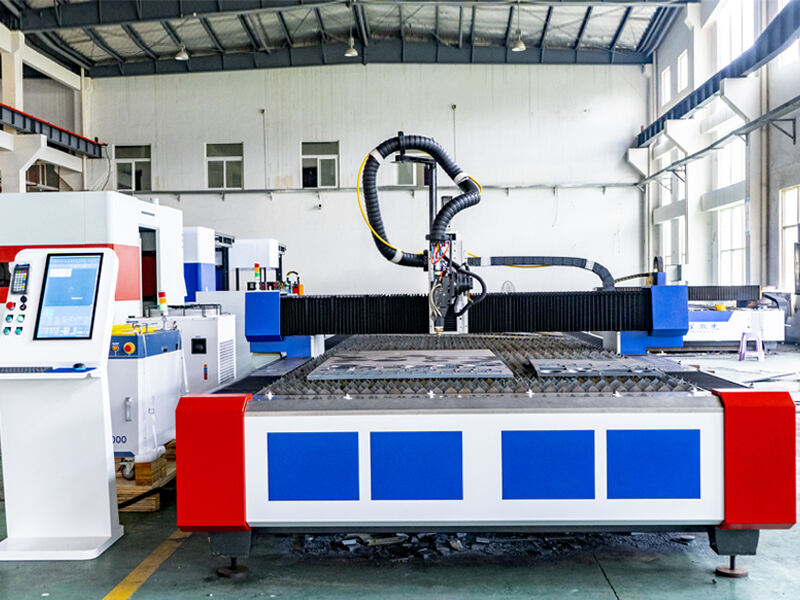
A fiber laser cutting machine can cut most metal materials including carbon steel, stainless steel, aluminum, copper, brass, and titanium alloys, with a maximum cutting thickness of up to 50mm for certain metals.
A servo press brake saves 30% to 60% energy compared to traditional hydraulic press brakes, thanks to servo motors and ball screws/servo pump systems that use power only during the bending process rather than continuously idling.
A swing beam shearing machine uses a rotary blade motion and is suited for thinner sheets and high-speed production, while a guillotine shearing machine features vertical blade movement, offering higher precision (adjustable cutting angle 0.5~2°) for thick plates and heavy-duty applications.
A handheld welding machine is ideal for on-site welding, repairing large workpieces, welding difficult-to-move structures, steel structure field splicing, mold repair, and advertising sign welding, offering flexibility and ease of use without requiring professional welders.

Related Articles

How To Use Fiber Laser Cutting Machine To Improve The Utilization Rate Of Sheet Metal?

27

Nov

How To Use Fiber Laser Cutting Machine To Improve The Utilization Rate Of Sheet Metal?

View More
The 136th RAYMAX Canton Fair was kicked off

27

Nov

The 136th RAYMAX Canton Fair was kicked off

View More
The Ultimate Guide to Choosing the Right Press Brake Machine

The Ultimate Guide to Choosing the Right Press Brake Machine

Discover the types of press brake machines, including hydraulic, CNC, and hybrid designs. Learn about calculating press brake requirements and minimizing springback effects. Explore advanced features that enhance precision and safety in manufacturing.
View More
RAYMAX Shines at FABTECH, Smart Bending Shapes the Future!

19

Sep

RAYMAX Shines at FABTECH, Smart Bending Shapes the Future!

View More

Customer Reviews

Sarah Zhang

RAYMAX fiber laser welding machine has significantly improved our battery pack assembly line. The 1.5kW fiber laser with closed-loop feedback system ensures consistent weld penetration on copper tabs. The swing welding head bridges gaps up to 1.5mm, accommodating slight variations in tab alignment. Weld speed of 80 mm/s on 0.3mm copper has increased our throughput. The heat-affected zone is minimal, preventing damage to sensitive cell internals. The machine's real-time weld monitoring and data logging support our ISO quality requirements. The parameter library preloaded for 30 material combinations saved us development time. Their application engineer helped optimize settings for our specific materials.

Thomas Mueller

RAYMAX integrated a robotic fiber laser welding system into our production line for automotive aluminum components. The 6-axis robot achieves repeatability of ±0.02mm, essential for our lightweight structural parts. The welding speed of 120 mm/s with 3mm penetration on aluminum alloys has doubled our previous throughput. The real-time seam tracking compensates for part variations. The closed-loop feedback ensures consistent weld quality across batches. The integration with our MES system for weld data logging supports traceability requirements. RAYMAX's engineering team provided thorough integration support and operator training. This system has become a critical part of our lightweight vehicle component production.

Get a Free Quote

Our representative will contact you soon.
Email
Mobile/WhatsApp
Name
Company Name
Message
0/1000
Minimal Heat-Affected Zone for Precision Metal Joining

Minimal Heat-Affected Zone for Precision Metal Joining

RAYMAX fiber laser welding machine delivers strong, clean welds with a concentrated heat-affected zone that minimizes distortion, making it ideal for welding thin sheets and heat-sensitive components. With fiber laser wall-plug efficiency exceeding 30%, energy costs are reduced by up to 50% compared to traditional CO₂ systems. Available in pulsed and continuous wave modes, this machine excels in applications such as lithium battery tab welding, medical device manufacturing, and automotive lightweight component assembly, ensuring consistent weld quality across production batches.